

GROUP STRUCTURE

SAM ENGINEERING & EQUIPMENT (M) BERHAD
(199401012509 (298188-A))
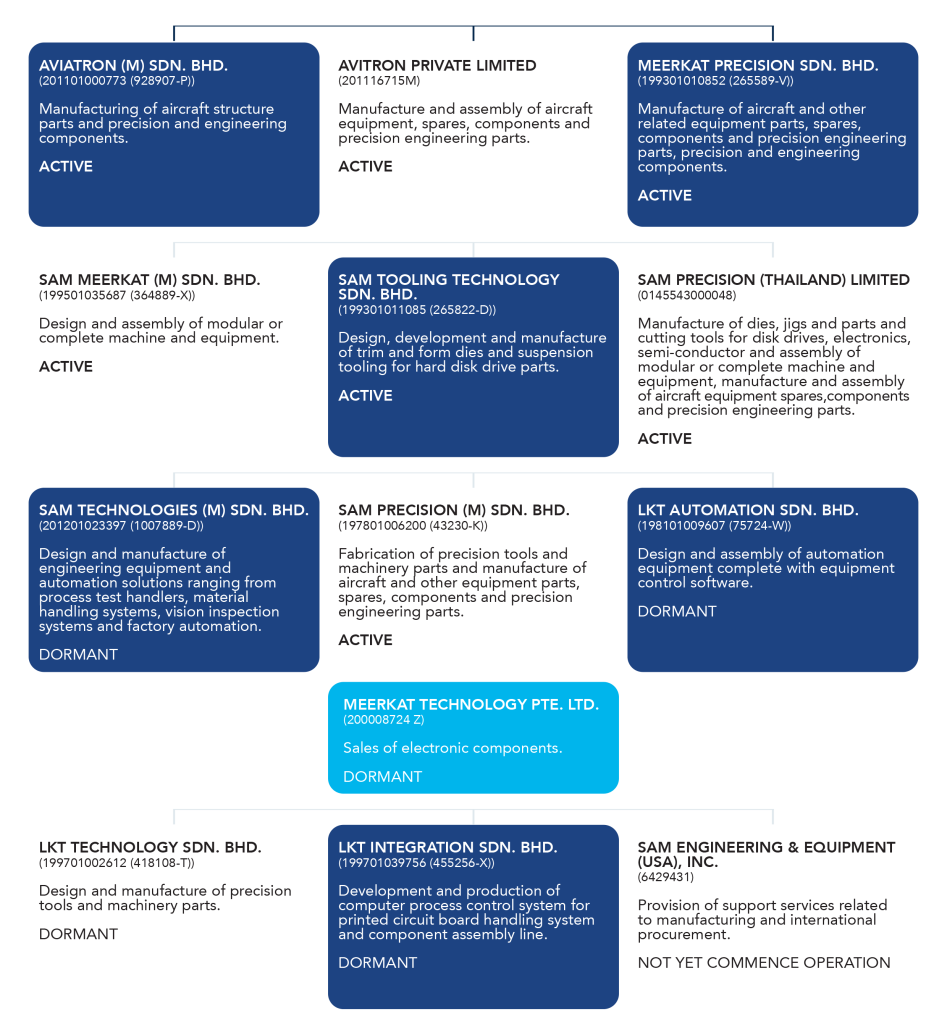
1
SAM Precision (M) Sdn. Bhd.
2
SAM Precision (M) Sdn. Bhd./
SAM Tooling Technology Sdn. Bhd.
3
Meerkat Precision Sdn. Bhd./
Corporate Office
4
SAM Meerkat (M) Sdn. Bhd.
5
SAM Precision (Thailand) Limited
(Ayutthaya Province)
6
SAM Precision (Thailand) Limited
(Chonburi Province) - Buildings 1 & 2
6
SAM Precision (Thailand) Limited
(Chonburi Province) - Building 3
7
Aviatron (M) Sdn. Bhd.
FINANCIAL HIGHLIGHTS
| Financial Year Ended | |||||
|---|---|---|---|---|---|
| 2022 | 2023 | 2024 | 2025 | 2026 | |
| REVENUE (RM’ 000) | 1,147,645 | 1,445,358 | 1,497,400 | 1,480,549 | 1,440,671 |
| PROFIT BEFORE TAX (RM’ 000) | 100,451 | 114,971 | 143,809 | 115,419 | 64,065 |
| PROFIT FOR THE YEAR (RM’ 000) | 75,455 | 88,849 | 108,581 | 91,921 | 44,742 |
| BASIC EARNINGS PER SHARE (Sen)* | 13.94 | 16.41 | 19.53 | 13.58 | 6.61 |
| DILUTED EARNINGS PER SHARE (Sen)* | 13.94 | 16.41 | 19.53 | 13.58 | 6.61 |
* Adjusted to reflect the bonus issue which was completed on 3 March 2022.
| Financial Year Ended | |||||
|---|---|---|---|---|---|
| 2022 | 2023 | 2024 | 2025 | 2026 | |
| DIVIDEND PER SHARE (Sen)* | 3.50 | 2.50 | 3.30 | 2.80 | 1.40 |
| CASH AND CASH EQUIVALENTS (RM’ 000) | 31,063 | 21,045 | 36,244 | 27,982 | 24,609 |
| NET ASSETS PER SHARE (RM)* | 1.28 | 1.50 | 2.12 | 2.11 | 1.96 |
| RETURN ON EQUITY (%) | 11.4 | 11.8 | 9.7 | 6.4 | 3.3 |
REVENUE
(RM’ 000)
PROFIT FOR THE YEAR
(RM’ 000)
PROFIT BEFORE TAX
(RM’ 000)
BASIC EARNINGS PER SHARE
(Sen)
DIVIDEND PER SHARE
(Sen)
NET ASSETS PER SHARE
(RM)
CASH AND CASH EQUIVALENTS
(RM’ 000)
RETURN ON EQUITY
(%)
MANAGEMENT DISCUSSION AND ANALYSIS
FINANCIAL PERFORMANCE OVERVIEW
For the financial year ended 31 March 2026 (“FY2026”), the Group recorded total revenue of RM1,440.7 million and profit
before tax (“PBT”) of RM64.1 million.
Business Segment Review
Aerospace
The Aerospace business recorded revenue of RM545.4
million, representing an increase of 4.0% over the preceding
financial year. The improvement was mainly driven by higher
sales of casing and structure products, partially offset by
unfavourable foreign exchange movements arising from
the weakening of the United States Dollar (“USD”) against
the Malaysian Ringgit (“RM”).
Despite the higher revenue, the Aerospace business
recorded a loss before tax (“LBT”) of RM13.1 million,
compared with a profit before tax of RM3.9 million in the
preceding financial year. The weaker performance was
mainly attributable to higher start-up costs in Thailand,
transitional costs arising from the relocation of casing
operations from Singapore to Thailand, and unfavourable
foreign exchange impact resulting from the weakening of
the USD. In addition, compensation received for defective materials in the preceding financial year did not recur in
FY2026.
Equipment
The Equipment business recorded revenue of RM895.3
million, representing a decrease of 6.4% from the preceding
financial year, mainly attributable to unfavourable foreign
exchange translation arising from the weakening of the
USD.
PBT for the Equipment segment declined by 30.8% to
RM77.2 million, primarily due to unfavourable foreign
exchange impact arising from the weakening of the USD
and under-recovery of costs resulting from lower capacity
utilisation.
Group Performance
The Group’s total revenue declined by 2.7% to RM1,440.7 million. PBT decreased by 44.5% to RM64.1 million, while profit
after tax declined by 51.4% to RM44.7 million.
During FY2026, the Group invested RM103.1 million, primarily to support the relocation of casing operations from Singapore
to Thailand, as well as its ongoing expansion in Thailand.
As at year-end, the Group’s projected order book stood at RM5.3 billion.
FINANCIAL POSITION
DIVIDEND
An interim single-tier dividend of 1.40 sen per ordinary
share was declared in May 2026, representing 20% of the
Group’s net profit. Based on the average share price for
June 2026 of RM4.70, the dividend of 1.40 sen per share
translates into a dividend yield of 0.30%.
Dividend Per Share
(RM’million)
CUSTOMERS AND PROGRAMS
Aerospace
In FY2026, the Aerospace segment generated RM 545.4
million in revenue, representing a 4.0% increase compared to the previous financial year. The increase was attributable
to the expected aerospace supply chain ramp-up across
Airbus and Boeing programs for all aerospace products.
However, growth was moderated by the strengthening of
Malaysian Ringgit against the US Dollar, as contracts are
denominated in US Dollar.
Our Thailand facility began volume production of engine
cases in January 2026, and started delivering to customers
in FY2026, compared with the prior financial year, which
primarily focused on customer and product qualifications.
In November 2025, SAMEE was honoured with the
prestigious Risk Mitigation Award at the RTX Supplier
Conference 2025. This recognition reflects SAMEE’s strong
commitment to reliability and supply chain excellence.
Through the successful ramp-up of production to address
a critical supply chain gap, SAMEE enabled Collins
Aerospace, one of RTX’s major business segments, to
maintain smooth supply chain operations and achieve its
production targets. SAMEE is proud of this accomplishment
and remains committed to being a trusted partner to its
aerospace customers.
The Group continues to be well-positioned with sufficient
capacity to support future production rate increases in the
aerospace industry.
Equipment
In FY2026, the Equipment segment recorded revenue
of RM895.3 million, representing a 6.4% decline from the previous financial year. The decrease was primarily
attributable to the strengthening of the Malaysian Ringgit
against the US dollar, as the majority of orders in this
segment are denominated in USD. Excluding the impact
of foreign exchange movements, customer demand in the
Equipment segment remained stable in FY2026 compared
with FY2025.
During the financial year, the Group secured several
new projects and New Product Introduction (“NPI”)
programmes as customers expanded their production
activities in Asia. These projects are expected to contribute
to future production volumes and further strengthen the
Group’s long-term business position. Historically, the
Group’s front-end semiconductor equipment business has
been more US-centric. In FY2026, the Group was added to
the Approved Vendor List (“AVL”) of new customers outside
the United States after meeting stringent qualification and
selection requirements. This development is strategically
important as it supports the diversification of the Group’s
customer base beyond regional concentration and
broadens its exposure beyond semiconductor front-end
product segments. Nevertheless, contributions from these
newly secured projects are expected to be gradual, but
they are anticipated to support the Group’s longer-term
growth.
In February 2026, SAMEE was honoured to receive the
Supplier Excellence Award 2026 from Applied Materials
Inc., a global leader in materials engineering solutions
for the semiconductor front-end equipment industry. The
award recognises Applied Materials’ global suppliers for
outstanding technical and operational achievements across
key areas including quality, service, sustainability, lead time,
delivery, and competitiveness. SAMEE was recognised for
Best-in-Class Performance in contract manufacturing.
The Group remains cautiously optimistic on the outlook
of the semiconductor equipment segment and has added
capacity in Thailand ready to support future growth
opportunities.
OPERATIONS INITIATIVES
Aerospace
During the financial year, the Group continued to
advance its aerospace strategy, with significant progress
in Thailand, reinforcing its position in high-value engine
casing manufacturing.
A key milestone achieved was the successful completion
of customer site qualification for the Thailand aerospace
operations. This enables the Group to transition into the
next phase of ramp-up and volume production, marking
a critical step in establishing Thailand as a core aerospace
manufacturing hub.
In parallel, the Group made substantial progress in
expanding aerospace capabilities and capacity in Thailand.
To support increasing demand and enhance manufacturing
capability, new Computer Numerical Control (CNC)
machines and special process facilities were installed
and commissioned during the year. These investments
strengthen operational capacity and position the Group to
support highly complex aerospace programs.
In line with the Group’s strategy to consolidate aerospace
operations and optimise cost competitiveness, our
manufacturing facility in Jurong, Singapore was closed
during the year following the successful relocation of its
operations to Thailand. This marks a strategic transition
towards a more centralised and efficient aerospace
manufacturing base.
Another major milestone was the completion of the third
building at the Ban Bueng facility, Thailand (BB3), which
significantly expands the Group’s aerospace footprint. The
facility is designed with scalability in mind, enabling future
capacity expansion and supporting long-term growth in
aerospace demand.
Equipment
The Equipment business continued to strengthen its core
capabilities and operational efficiency, in line with the
Group’s long-term strategy to enhance competitiveness in
semiconductor and industrial equipment manufacturing.
During the year, the Group expanded its advanced
manufacturing capabilities, with a focus on improving
process complexity, precision, and overall customer value
add. These enhancements support the Group’s ability
to secure higher-value programs and deepen customer
engagement.
In line with its automation roadmap, the Group increased
the adoption of automation technologies across
manufacturing operations. This includes the scaling of
automated and semi-automated processes to improve
productivity, consistency, and labour efficiency, while
reducing reliance on manual operations.
In addition, the Group enhanced operational visibility
through the implementation of a real-time manufacturing
dashboard system. This provides improved monitoring
of production performance, machine utilisation, and key
operational metrics, enabling faster decision-making,
better resource allocation, and more proactive issue
resolution across facilities.
OUTLOOK
Aerospace
Air passenger travel has continued its strong growth
momentum through 2025 and into early 2026. According
to the International Air Transport Association (IATA),
total passenger traffic measured by Revenue Passenger
Kilometers (RPKs) reached 2.2 trillion RPK in Q1 2026, up
4% year-on-year1.
The commercial aerospace sector remains underpinned by
robust long-term fundamentals, as the global airline fleet
is expected to almost double in the next 20 years2, with an
even proportion of new deliveries meant to replace older
less fuel-efficient aircraft2. Driven by this sustained demand
for fleet growth and renewal, Airbus and Boeing maintain
historically high order backlogs, with a combined total of
15,750 aircraft as of March 2026. These backlogs represent
10.43 years of future deliveries for Airbus, and 10.13 years
for Boeing, reflecting multiple years of production visibility
while also driven by persistent supply chain bottlenecks.
To support the supply chain ramp-up, OEMs and their
suppliers continue to actively invest in capacity expansion.
Near-term uncertainty in global travel demand remains
due to the ongoing Middle East conflict, particularly as
rising jet fuel prices translate to higher costs for airlines
and passengers. Meanwhile, geopolitical uncertainties
resulting in trade restrictions and cost inflation pressures
present continued risks to the aerospace supply chain. In
response, OEMs are accelerating efforts in supply chain
diversification to derisk and enhance resilience.
Against this backdrop, we will continue to strengthen our
workforce capability, operational capacity, and production
readiness to support our customers’ production ramp-ups.
By investing in our manufacturing footprint, we position
ourselves as a strategic partner to improve supply chain
resilience for our customers, driving long-term value
creation in this dynamic global environment.
- International Air Transport Association (IATA)’s Quarterly Air Transport Chartbook Q1 2026. IATA represents over 360 airlines comprising 85% of global air traffic.
- Airbus Global Market Forecast 2025. Boeing Commercial Market Outlook 2025-2044.
- Forecast International: Airbus and Boeing Report March 2026 Commercial Aircraft Orders and Deliveries.
Equipment
According to SEMI’s Worldwide Semiconductor Equipment
Market Statistics (WWSEMS) Report released on April 7,
2026, global semiconductor equipment billings increased
by 15% year-on-year to USD135.1 billion in 2025, supported
by investments in advanced logic, high-bandwidth memory
(“HBM”), and advanced packaging driven by demand
from artificial intelligence (“AI”) and high-performance
computing (“HPC”). Front-end and back-end segments
recorded growth, with test and assembly equipment
benefiting from increasing device complexity.
In 2026, equipment spending is expected to remain
supported by AI-related demand and investments in
leading-edge technologies. However, capital spending
remains selective, with continued focus on advanced nodes
and advanced packaging, while mature node investments
remain cautious. Industry utilisation levels also remain
mixed due to ongoing inventory normalisation and varying
demand across end markets. As the Group supports
customers in the front-end semiconductor equipment
segment, the Group is well positioned to benefit from the
ongoing industry upcycle and continued investments in
advanced semiconductor manufacturing and technology
upgrades.
Over the medium to long term, structural trends such as
digitalisation, electrification, and increasing semiconductor
content are expected to continue underpinning industry
growth. Nevertheless, geopolitical developments, ongoing
supply chain regionalisation, and uncertainties arising from
global trade policies and conflicts in the Middle East may
continue to influence investment decisions and market
conditions.